
Living in Farmington, Utah: An Honest Guide from a Local Realtor
Most people meet Farmington by accident. They get off I-15 for a movie at Station Park, or they follow the roller coasters at Lagoon, and they notice that ten minutes later they are on a quiet street of old brick houses under enormous trees with the Wasatch right on top of them. Farmington does that. It is a freeway exit and a nineteenth-century town center at the same time.
This is the guide I give people who are seriously considering it — what it costs, where the neighborhoods are, how the commute actually goes, and what there is to do when you are not working. I am going to tell you the parts that are less flattering too, because you will find them out in month three anyway.
Farmington at a glance
|
25,389
Population
|
$127,338
Median household income
|
$697,669
Average home value (Zillow, June 2026)
|
21.7 minutes
Mean commute to work
|
| Elevation | 4,246 feet |
| Average annual snowfall | 48.6 inches |
| County | Davis County — Farmington is the county seat |
What does it cost to buy a home in Farmington?
As of mid-2026, the average Farmington home value sits around $697,669, up about 3.3% over the prior year. The Census Bureau's most recent estimate of median home value for the city is $650,700. Those two numbers measure slightly different things, which is why they do not match — but together they tell you the honest story: Farmington is a high-$600s to low-$700s town, and it has been climbing slowly rather than lurching.
I would rather tell you this plainly than let you discover it on a Saturday: if your budget is under about $500,000, Farmington is going to be very tight. You will be looking at townhomes and condos, older smaller homes needing work, or you will be looking in a neighboring city. That is not a knock on your budget — it is just what this particular ten square miles costs right now. Centerville to the south and Clearfield to the north both stretch a dollar further.
What you get for the money varies more here than in a typical suburb, because Farmington's housing stock is genuinely mixed:
- Historic homes near Main Street, some of them well over a century old, on deep lots with mature trees. Charm and character, and also the maintenance realities that come with a house built before anyone had heard of a building code.
- 1970s–1990s family homes on the bench and through the middle of town — the bread and butter of the Farmington market.
- Newer construction on the west side, built out over the last two decades as Farmington grew toward the lake. Bigger, more efficient, more uniform, usually with an HOA.
- Townhomes and condos, concentrated near Station Park and the west side, which are the realistic entry point into the city.
If you want to know what a specific price actually buys today, ask me — a live number beats a blog post that is six months old.
Is Farmington expensive to live in?
Overall, yes, modestly. Cost-of-living data puts Farmington around 7% above the U.S. average, and the reason is almost entirely housing. Groceries and utilities in this part of Utah tend to run at or below national levels. What pushes the number up is the mortgage and, to a lesser degree, transportation — this is a two-car county for most families.
Two things worth budgeting for that people forget:
Property taxes and the primary residence exemption. Utah taxes a primary residence at a reduced rate compared with a second home or a rental. If you are buying an investment property here, run the numbers with the non-primary rate, not the one on the listing.
Water and yard. Those beautiful mature-tree lots near Main Street come with real irrigation and landscaping costs in a dry state. A big lot in Farmington is a lifestyle choice with a monthly price attached.
What Farmington does not have is a city income tax or anything exotic — the surprises here are ordinary.
What are the neighborhoods in Farmington?
Here is where I am going to be straight with you rather than reciting subdivision names off a marketing map. Farmington is a small city, and locals mostly think in terms of five areas, not dozens of named neighborhoods. Each has a different feel and a different price.
The Historic District and Old Farmington. The Farmington Main Street Historic District runs along Main Street roughly from 200 South to 600 North and contains 66 contributing historic buildings — homes, churches, the old city hall, the courthouse. It was added to the National Register of Historic Places in 2011. This is the walkable, tree-canopied, front-porch part of town, and it is where Farmington Elementary and Farmington Junior High sit. Prices here reflect scarcity and charm, and inspections matter more than usual.
The East Bench. Above the historic core, climbing toward the mountains and the Highway 89 corridor. Bigger lots, mountain views, and the Oakridge Country Club golf course at 1492 Shepard Lane sitting in the middle of it. This is generally the higher end of the Farmington market. The trade-off is steeper streets and a longer trip to the freeway.
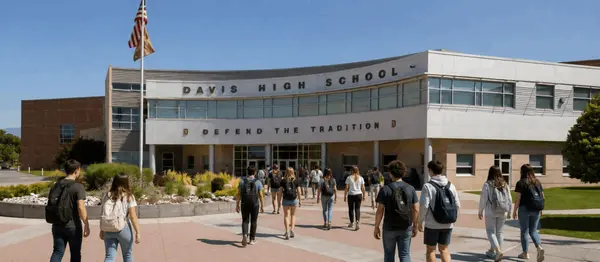
Farmington Ranches. The established west-side neighborhood, with its own Ranches Park on Ironside Way. Newer than the historic core, family-heavy, more uniform housing, and closer to Farmington High and the west-side elementaries.
The Station Park / Farmington Station area. Built around the FrontRunner station and the 62-acre Station Park shopping center. This is where you find townhomes, condos, and the most genuinely walkable-to-things living in the city. If you commute by train or you want to walk to dinner and a movie, this is your area. It is also the loudest and busiest part of Farmington, which some people love and some people cannot stand.
The north side, around Shepard Lane and Glovers Lane. Newer subdivisions and the newest schools — Knowlton Elementary is on Shepard Lane, Farmington High is on Glovers Lane. Popular with families who want a newer house and a short school run.
A caution I give every buyer: these areas overlap, and HOA rules, lot sizes and school boundaries can change from one street to the next inside any of them. When you get to a specific address, ask me for the subdivision-level detail — the HOA, the age of the build, and the actual school assignment. That is a per-house question, not a per-neighborhood one.
What about the schools?
Farmington has four elementary schools, its own junior high, its own high school, and a charter school inside the city limits — all within Davis School District, which runs K–6, 7–9, and 10–12.
Schools are usually the single biggest driver of where a family lands in this city, and the boundaries do not follow the lines you would guess. I wrote a full guide with every school, its grade levels, its address, and its own website, plus the answers to the questions I get asked most:
→ Best Schools in Farmington, Utah: A Parent's Guide
The short version: two Farmington elementaries — Canyon Creek and Eagle Bay — host Spanish dual language immersion, Farmington High only opened in 2018 so older advice about high schools here is out of date, and you should never trust the school names printed on a listing. Verify the address.
How bad is the commute?
Better than you would expect, and this is one of Farmington's real advantages.
The mean commute for a Farmington resident is 21.7 minutes. For context, that is a shorter average trip than most Wasatch Front suburbs at this distance from Salt Lake, and the reason is geography: Farmington sits at the junction of I-15, US-89, and Legacy Parkway, so there are three genuinely different ways south instead of one.
| Route | Good for |
|---|---|
| I-15 south | Downtown Salt Lake, the airport, points south. The default, and the one that backs up. |
| Legacy Parkway | A quieter, no-trucks alternative running parallel to I-15 through west Davis County. Often the better call at rush hour. |
| US-89 | The bench route north toward Kaysville, Layton and Ogden, away from the freeway. |
| FrontRunner commuter rail | Salt Lake and Ogden without driving at all. |
The FrontRunner station is the thing people underrate. Farmington Station sits at 450 North 850 West, opened in 2008, has roughly 874 free parking spaces, and puts you on a train to downtown Salt Lake or up to Ogden without touching the freeway. Three UTA bus routes connect there as well. If one person in your household works downtown, this station is worth real money to you, and it is a big part of why the Station Park area holds its value.
Going north to Ogden or Hill Air Force Base is the easy direction — you are driving against the heaviest flow.
What is there to do outdoors?
A lot, and most of it is free. Farmington is squeezed between the Wasatch Mountains and the Great Salt Lake, which means you get both mountain and wetland recreation inside city limits.
Farmington Pond (750 North 75 West) sits at the mouth of Farmington Canyon and is the town's default outing — stocked fishing, a walking loop, and a trailhead into the canyon. Bring a kid and a cheap rod and you have solved a Saturday morning.
Farmington Canyon climbs east from the pond up toward Bountiful Peak and the Skyline Drive country. It is a serious canyon road, not a paved scenic drive — but it is right there, and in September it is worth the trip for the color alone.
The Bonneville Shoreline Trail runs the bench above town, following the ancient shoreline of Lake Bonneville. Farmington maintains a Davis County section of it. It is the local go-to for a quick hike or trail run with a valley view, and you can reach it without driving anywhere.
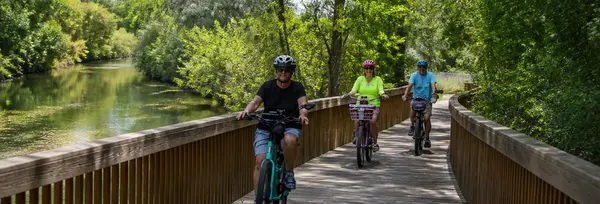
The Legacy Parkway Trail is the opposite kind of trail — a paved, flat, multi-use path running alongside Legacy Parkway on the west side. Good for road cycling, strollers, and anyone who wants distance without elevation.
Farmington Bay Waterfowl Management Area stretches out toward the Great Salt Lake at the western edge of town. It is one of the better birding spots in the state, with bald eagles in winter, and it is quiet in a way that surprises people who only know Farmington from the freeway.
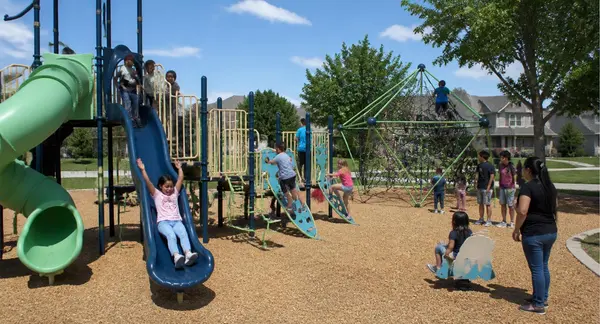
The city also keeps a good spread of neighborhood parks, including Woodland Park (300 South 200 East), Ezra T. Clark Park (25 North 400 West), Forbush Park (100 South Main), Shepard Park (760 West Shepard Lane), Heritage Park (1591 North 1075 West), and Ranches Park (136 West Ironside Way).
And then there are the two things Farmington is famous for. Lagoon, open since 1886 and sitting on about 100 acres right in town, which means season passes are a normal line item in family budgets here and traffic on a summer Saturday is a normal complaint. And Station Park, the 62-acre open-air center by the train station with a 16-screen Cinemark, REI, Apple, Best Buy, and a long row of restaurants — effectively Davis County's living room.
For organized sports, the Davis County Legacy Events Center at 151 South 1100 West hosts county events, the fair, and a large sports campus.
So who is Farmington actually right for?
It is a strong fit if: you want a real town center rather than a subdivision with a sign at the entrance; you or your spouse commutes to Salt Lake and would use the train; you have school-age kids and want everything from kindergarten to graduation inside one small city; you want mountains and trailheads within ten minutes of your driveway.
It is a harder fit if: your budget is under about $500,000 and you want a single-family home with a yard; you want a large new-construction house on a big lot for the money, which northern Davis County does better; or you are sensitive to summer traffic and event noise, in which case you want to be honest with yourself about how close to Lagoon and Station Park you are willing to live.
The thing nobody tells you: Farmington is small and it is the county seat, which gives it a civic density you do not usually get at this size — the county buildings, the fairgrounds, the historic district, the train. It feels like a town that decided what it was a long time ago. Whether that is charming or limiting depends entirely on you.
If you are thinking about Farmington
I am a Realtor with Real Broker, I work Farmington and the Davis County cities around it, and I have had four children go through Davis County schools. I list homes for sellers and I represent buyers, and I would rather tell you Farmington is wrong for you than sell you a house you regret.
If you want to talk it through, tell me your budget, your commute, and whether schools are driving the decision, and I will tell you honestly which parts of Farmington are realistic and which are not — and if the answer is Kaysville or Centerville instead, I will tell you that too.
Julie Burningham, Realtor — Real Broker
Categories
- All Blogs (45)
- Bountiful, Utah (3)
- Centerville, Utah (3)
- Clearfield, Utah (3)
- Clinton, Utah (3)
- East Bench Real Estate (1)
- Farmington, Utah (3)
- Fruit Heights, Utah (3)
- Kaysville, Utah (3)
- Layton, Utah (3)
- North Salt Lake, Utah (3)
- South Weber, Utah (3)
- Sunset, Utah (3)
- Syracuse, Utah (3)
- West Bountiful, Utah (3)
- West Point, Utah (3)
- Woods Cross, Utah (3)
Recent Posts


GET MORE INFORMATION